
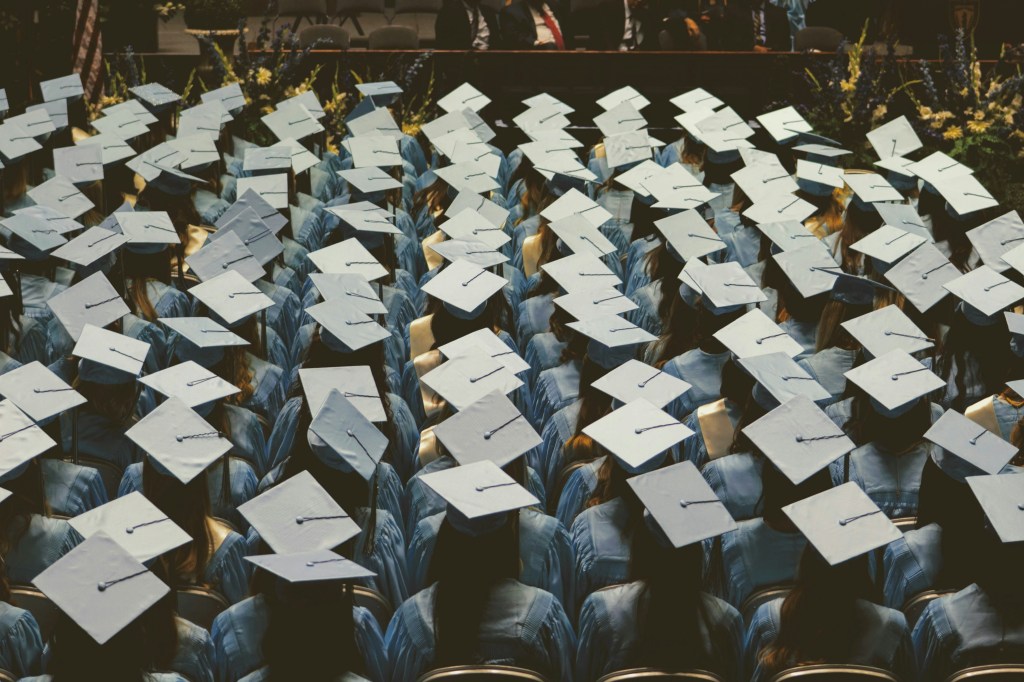
Picture this: an ivory-clad campus buzzing with ambitious students discussing Derrida and deconstructing capitalism. Now contrast it with a factory floor, where hardworking men and women clock in and out, watching the news in snippets between shifts. Two very different worlds, yet both deeply tied to the same country’s political destiny. Welcome to the diploma divide—where your level of education increasingly predicts your political leanings.
For decades, education has been a great social equalizer, or at least it pretended to be. Now, it’s a dividing line, as sharp as it is consequential.
Gone are the days when Democrats and Republicans shared a broad swath of common ground. Today, those with college degrees lean left, while those without lean right. It’s a tale of two electorates, and neither is particularly inclined to understand the other.
This topic is discussed in greater detail in Own The Libs: Politics is the New Personality. To grab your copy, click the link below.
How did we get here?
It’s tempting to blame this split on the usual suspects: media echo chambers, economic inequality, or social media algorithms. But the truth is more nuanced. At its core, the diploma divide reflects a broader cultural and economic shift. Higher education has become synonymous with liberal values, intellectual elitism, and, let’s be honest, the coastal bubble. Meanwhile, those who skipped college often feel alienated from this world and, consequently, from the political ideologies associated with it.
The irony? Both groups are convinced they have the moral high ground. The degree-holding liberal assumes their worldview is informed and enlightened, a product of their exposure to diverse ideas and complex arguments. The non-degree-holding conservative, meanwhile, prides themselves on their common sense and connection to “real” America—the one that doesn’t have time for woke Twitter debates or academic jargon.
Education as identity
The diploma divide isn’t just about education; it’s about identity. College is more than a place to learn; it’s a cultural experience. It’s where you’re likely to encounter new perspectives, make friends from different backgrounds, and, yes, adopt the political leanings of your professors. Studies show that the more education you have, the more liberal you’re likely to become—particularly on social issues like immigration, climate change, and gender equality.
On the flip side, skipping college doesn’t mean skipping an education. It means learning in a different way—through life, work, and community. It’s a school of hard knocks that teaches resilience, practicality, and a healthy skepticism of elites. To many conservatives, the liberal college graduate is out of touch, more concerned with pronouns than paychecks, more fluent in theory than reality.
The perils of stereotyping
Let’s not pretend these stereotypes are harmless. They fuel division, perpetuating the idea that we’re not just different but incompatible. The diploma divide becomes a self-fulfilling prophecy. Liberals mock conservatives as ignorant, while conservatives dismiss liberals as arrogant. Neither side stops to consider the complexity of the other’s experiences.
Take economic anxiety, for example. Many conservatives without degrees feel left behind by a system that prioritizes tech jobs over manufacturing, urban centers over rural communities. They’re not wrong. The economic policies championed by liberal elites often exacerbate these disparities, even as they tout equality and inclusion. Meanwhile, college-educated liberals bemoan the rising cost of housing, student debt, and the gig economy—issues conservatives sometimes dismiss as self-inflicted.
The role of media
If education creates a spark in the colliding masses divided by diplomas, media pours gasoline on the fire. Conservative outlets like Fox News capitalize on the resentment felt by non-degree holders, painting college-educated liberals as elitist and out of touch. Liberal media isn’t innocent either, often portraying conservatives as backward or bigoted.
Social media amplifies these narratives, turning disagreements into culture wars. Algorithms feed us content that reinforces our beliefs, making it easier to dismiss opposing viewpoints. The result? A feedback loop where the diploma divide grows ever wider, fueled by mistrust and misunderstanding.
Bridging the gap – if we at all can
So, what’s the solution? How do we bridge a divide that seems to widen with each election cycle? It starts with recognizing that both sides have valid concerns. The liberal college graduate isn’t inherently arrogant, just as the conservative high school graduate isn’t inherently ignorant. Both are products of their environments, shaped by experiences that deserve respect.
We also need to rethink how we talk about education. College isn’t the only path to success, and it shouldn’t be the only path to respect. At the same time, dismissing higher education as elitist ignores its value in fostering critical thinking and innovation.
Finally, we need to hold our media accountable. Outrage sells, but it’s tearing us apart. Instead of sensationalizing the diploma divide, media outlets should focus on stories that highlight shared values and common ground.
Beyond the divide
The diploma divide is a symptom of a deeper issue: our inability to see each other as individuals rather than caricatures. It’s easy to reduce someone to their education level, their political affiliation, or their zip code. It’s harder to engage with them as a whole person, to understand their struggles and aspirations.
But if we want to move beyond the diploma divide, that’s exactly what we need to do. It’s not about agreeing on everything; it’s about recognizing that our differences don’t have to divide us. After all, we’re more than our degrees—or lack thereof.
 JQCO.PhD
Leave a comment